Custom T-Shirts, Embroidery, and Branded Apparel in Ocala: What’s the Best Option for Your Business?
You need branded apparel for your business. Maybe it’s uniforms for your team, shirts for an upcoming event, hats for a trade show giveaway, or custom merchandise for a product launch.
The question isn’t whether to do it. It’s how.
There are three main methods for putting your logo or design on apparel: screen printing, direct to film printing (DTF), and embroidery. Each one produces a different result, works best in different situations, and comes with different cost structures.
Picking the wrong method for your order is one of the most common mistakes businesses make when ordering branded apparel. You end up with a product that doesn’t look right, costs more than it should, or doesn’t hold up the way you expected.
This guide breaks down each method clearly so you can make the right call before you order.
Screen Printing: Best for Larger Orders with Bold Designs
Screen printing is the most widely used method for custom apparel, and for good reason. When the conditions are right, it produces vibrant, durable prints at a cost per unit that drops significantly as quantity goes up.
How it works: A mesh screen is used to transfer ink directly onto the fabric. Each color in your design requires a separate screen, so simpler designs with fewer colors are more cost-effective to produce.
Best for:
- Orders of 24 or more pieces per design
- Designs with a limited number of colors, typically six or fewer
- Bold graphics, logos, and text that don’t require fine detail or color gradients
- T-shirts, hoodies, tote bags, and promotional items ordered in volume
- Events, school groups, sports teams, and business uniforms where consistency matters
Minimum order: 24 pieces per design, with higher minimums possible for multi-color designs.
Turnaround: Typically one to two weeks depending on complexity and current order volume.
Where it falls short: Screen printing isn’t the right call for small runs, highly detailed artwork, photographic images, or designs with gradients and many colors. The setup cost per color means low-quantity orders become expensive quickly.
DTF Printing: Best for Small Runs and Complex Designs
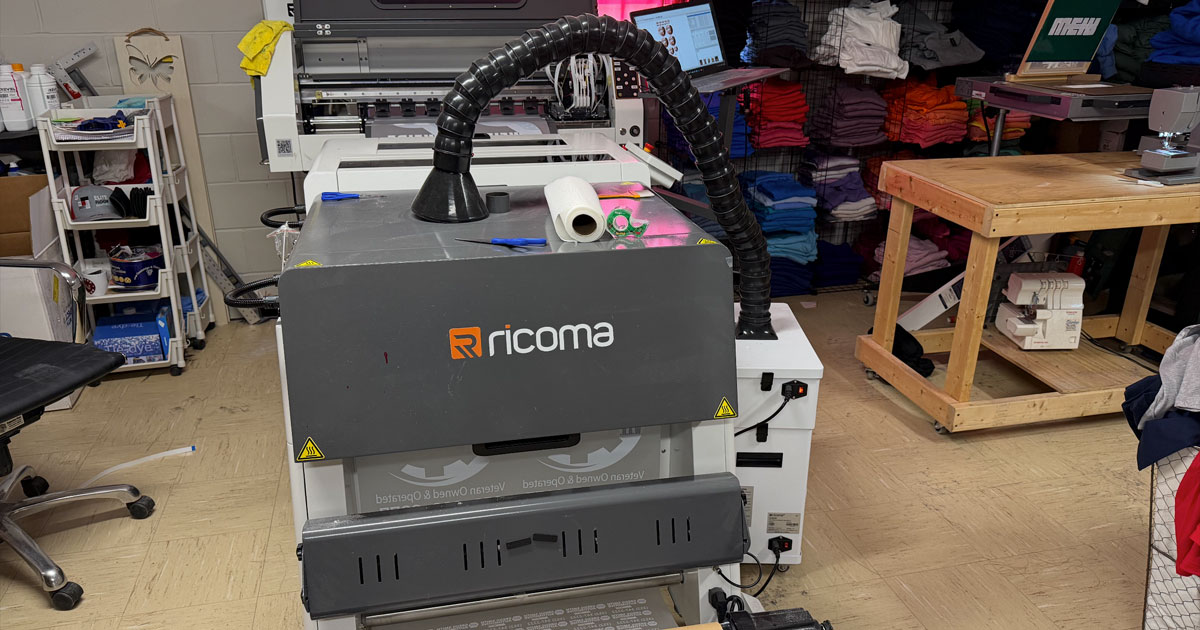
Direct to film printing is the newer method in the lineup and it’s changed what’s possible for small orders and detailed artwork. DTF prints a full-color design onto a special film, which is then heat-transferred onto the garment.
How it works: Your design is printed onto transfer film in full color using inkjet technology and then pressed onto the fabric with heat. There are no screens, no color limitations, and no minimum order requirements tied to design complexity.
Best for:
- Small runs, even single pieces or samples
- Designs with many colors, gradients, or photographic detail
- Mixed garment orders where you want the same design on different colors or styles
- Quick-turn orders when two weeks isn’t an option
- One-off custom pieces or limited runs for events
Minimum order: As low as one piece, making it the most flexible option for small businesses or special orders.
Where it falls short: Cost per unit stays relatively flat regardless of quantity, so DTF becomes less economical than screen printing for large orders with simple designs. The print also sits on top of the fabric rather than bonding into it, which can affect feel and longevity depending on care.
Our existing post on screen printing vs. DTF goes deeper on the direct comparison between those two methods if you want the full side-by-side breakdown.
Embroidery: Best for Professionalism and Longevity
Embroidery is in a different category from the other two. Instead of ink on fabric, embroidery stitches thread directly into the material. The result is a textured, dimensional look that signals quality in a way printing can’t replicate.
How it works: Your design is digitized into a stitch pattern and then stitched directly onto the garment using commercial embroidery equipment. There’s a one-time digitizing fee of $35 for custom logos, which you never pay again once it’s on file.
Best for:
- Polo shirts, jackets, and professional workwear where appearance matters
- Hats, beanies, and caps where embroidery is the standard expectation
- Tote bags, blankets, and premium branded gifts
- Business uniforms that need to hold up through frequent washing
- Any situation where you want the apparel to feel premium rather than promotional
Minimum order: As low as one piece.
Where it falls short: Fine detail, small text, and color gradients don’t translate well to embroidery. The stitching process has physical limitations around detail level that printing doesn’t have. Very intricate logos sometimes need to be simplified for embroidery to look clean.
Side-by-Side: Choosing the Right Method
Here’s a quick decision framework based on the most common scenarios Ocala businesses face.
You’re outfitting a team with uniforms:
Polo shirts and jackets with your logo — embroidery. T-shirts for a larger crew — screen printing if the order is 24 or more, DTF if it’s smaller.
You’re ordering event shirts:
Simple design, 50 or more pieces — screen printing. Complex design or mixed garment colors — DTF.
You’re making giveaway items for a trade show:
Promotional t-shirts in volume — screen printing. Branded hats — embroidery. Mixed small-run items — DTF.
You need a sample or a single piece before committing to a large order:
DTF. No minimums, fast turnaround, full color.
You want something that looks premium enough to sell or give as a gift:
Embroidery for structured items like hats and jackets. DTF or screen printing for soft goods depending on quantity.
Can You Mix Methods in One Order?
Yes, and for many businesses it’s the right answer.
A complete branded apparel strategy for an Ocala business might include embroidered polo shirts for the team, screen printed t-shirts for a seasonal promotion, and DTF hats for a trade show giveaway. Each method is doing the job it’s best suited for.
We handle all three under one roof, which makes coordination straightforward. You’re not managing three different vendors for three different products. One conversation, one order process, one point of contact.
Our custom embroidery services cover polos, hats, jackets, bags, and more. Our screen printing services handle custom t-shirts, promotional items, and event merchandise. And our DTF printing covers the small runs, complex designs, and quick-turn orders that neither of the other methods handles as well.
What to Have Ready Before You Order
Getting your order right starts before you contact us. Here’s what helps the process move faster.
Your artwork file. Vector format is best for all three methods: .ai, .eps, or .svg. High-resolution raster files at 300 DPI are acceptable in some cases. If you only have a low-res version of your logo, we can discuss options.
Your quantity. Even an approximate number helps us point you toward the right method and give you an accurate quote.
Your deadline. Standard turnaround for screen printing is one to two weeks. Embroidery timelines vary by order complexity. DTF is typically faster. If you have a hard event date, tell us upfront.
The garments. If you have specific styles, colors, or brands in mind, let us know. We carry a wide range of garment options and can help you pick the right base for your method and use case.
Ready to Place Your Order or Just Figuring It Out?
Either way, the easiest starting point is a quick conversation. We’ll look at your design, your quantity, your deadline, and your end use and tell you exactly which method makes the most sense.
No pressure to commit. Just a straight answer on the best path for your order.
Or reach out directly at (352) 233-9313 and we’ll get you sorted.