What Makes a Website Actually Convert? (A Plain-English Guide for Ocala Business Owners)
You can have a beautiful website and still hear nothing but silence.
No calls. No form submissions. No quote requests. Just visitors who show up, look around, and leave without doing anything.
This is one of the most frustrating situations a business owner can be in. You invested in a website. You’re getting some traffic. But the phone isn’t ringing.
The problem usually isn’t that your business isn’t good enough. It’s that your website isn’t doing its job.
A website that converts doesn’t happen by accident. It’s the result of specific decisions made about structure, messaging, speed, and user experience. This guide breaks down exactly what those decisions are so you know what to look for, and what to fix first.
What “Conversion” Actually Means
A conversion is any action a visitor takes that moves them closer to becoming a customer.
For most Ocala small businesses, that means a phone call, a form submission, a booking, or a request for a quote. It doesn’t have to be a purchase. It just has to be a meaningful next step.
If visitors are landing on your site and leaving without taking any of those actions, your site has a conversion problem, regardless of how it looks.
The Elements That Actually Drive Conversions
1. A Clear Headline That Tells Them They’re in the Right Place
Most business website headlines are vague. “Welcome to Our Website.” “Quality Service You Can Trust.” “Serving Central Florida Since 2005.”
None of that answers the one question every visitor is asking the moment they land: Is this the right place for my problem?
Your headline should tell them who you help, what you do, and what they get. In plain language. In about ten words.
If a first-time visitor can’t understand what you do within three seconds, they’re gone.
2. One Primary Call to Action
This is where most business websites make a critical mistake. They give visitors too many choices.
Call us. Email us. Follow us on Facebook. Read our blog. Download our guide. View our gallery.
When everything is a priority, nothing is. Visitors get overwhelmed and do nothing.
Pick one primary action you want visitors to take and make it impossible to miss. Everything else is secondary. Your CTA should appear above the fold, repeat in the middle of the page, and show up again at the bottom.
3. Trust Signals That Do the Convincing Before You Do
By the time someone reaches your website, they don’t know you yet. They’re evaluating whether to trust you with their time, their project, and their money.
Trust signals are the elements that answer that unspoken question. They include things like client logos, real testimonials with names attached, case studies with actual outcomes, years in business, certifications, and photos of real people on your team.
Stock photos of people in suits shaking hands don’t build trust. Real photos of your actual work and your actual team do.
4. Mobile Experience That Doesn’t Make People Work for It
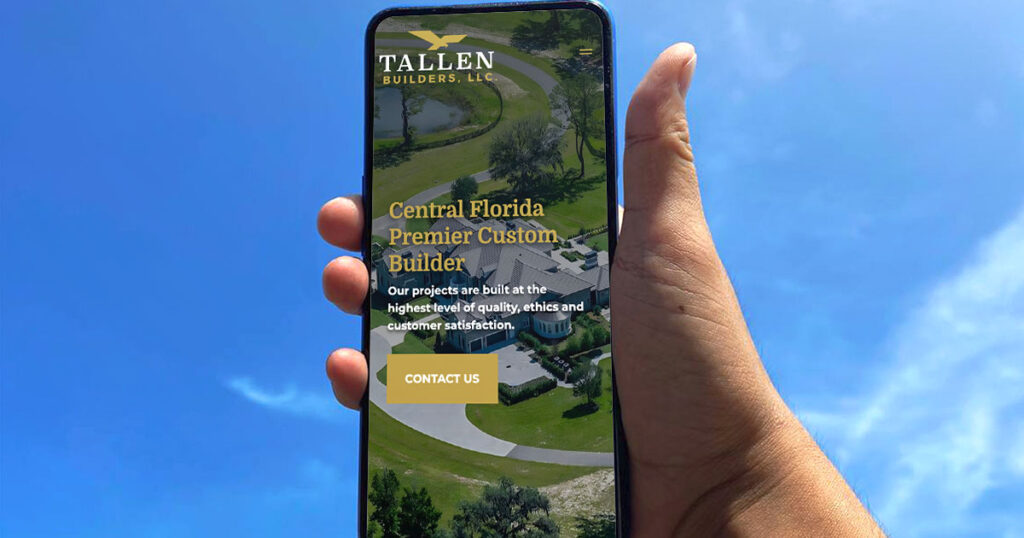
More than half of web traffic now comes from phones. If your website is hard to navigate on a mobile screen, you’re losing leads before they ever read a word.
Buttons that are too small to tap. Text that requires zooming. Navigation that collapses into a confusing menu. Contact forms that break on mobile. These aren’t minor annoyances. They’re conversion killers.
Your site should work just as well on a phone as it does on a desktop. If you haven’t checked recently, pull up your own website on your phone right now and try to contact yourself.
5. Page Speed That Doesn’t Make Them Wait
Visitors don’t wait for slow websites. Studies consistently show that if a page takes more than three seconds to load, a large portion of visitors leave before it finishes.
Page speed also affects your Google rankings. A slow site doesn’t just lose visitors. It loses visibility too.
If your site loads slowly, that’s not a cosmetic issue. It’s a direct hit to your leads and your rankings at the same time.
6. Messaging That Speaks to the Visitor, Not About You
There’s a pattern on a lot of business websites that kills conversions without the owner realizing it. It sounds like this:
“We are a family-owned company dedicated to providing exceptional service with over 20 years of experience and a commitment to quality.”
Every sentence is about the business. None of it addresses the visitor’s problem.
The most effective website copy is written from the visitor’s perspective. It names the problem they’re experiencing. It shows them the outcome they want. It makes them feel understood before it ever makes a pitch.
When visitors feel like a website is speaking directly to their situation, they stay longer, trust faster, and convert at a higher rate.
7. A Simple, Obvious Path to the Next Step
Visitors shouldn’t have to hunt for how to contact you.
Your phone number should be in the header on every page. Your contact form should be easy to find and short enough that people actually fill it out. Your CTA buttons should stand out visually and use action-oriented language like “Book a Free Call” or “Get a Quote” rather than generic labels like “Submit” or “Learn More.”
Remove every unnecessary step between a visitor and a conversion. Every extra click is another opportunity for them to leave.
What a Conversion-Focused Website Looks Like in Practice
This isn’t about making a website more aggressive or filling it with pop-ups. It’s about removing friction and creating clarity.
A conversion-focused website design leads every visitor through a clear path: here’s the problem you have, here’s how we solve it, here’s proof we’ve done it before, here’s exactly what to do next.
Every section earns its place. Every page has a job. And the whole thing is built around how your customer makes decisions, not around what you want to show them.
One Thing You Can Fix Today
If you want a quick gut check on your own site, ask yourself this one question:
If a stranger landed on my homepage right now with no prior knowledge of my business, would they know within five seconds what I do, who I help, and what to do next?
If the answer is no, or even “maybe,” that’s your starting point.
And if you want someone to walk through your site with you and identify exactly what’s holding it back, that’s exactly what we do in our strategy calls.
Getting found on Google is one thing. Getting found and converting that traffic into real leads is the whole point.
Ready to Find Out What’s Holding Your Site Back?
We’ll spend 30 minutes reviewing your website, your goals, and what’s keeping visitors from converting. No pitch. No pressure. Just a straight conversation about what your site needs to actually work.